Recommendations for a culturally sensitive and intersectional practice in suicide prevention intervention for public safety personnel: a qualitative approach
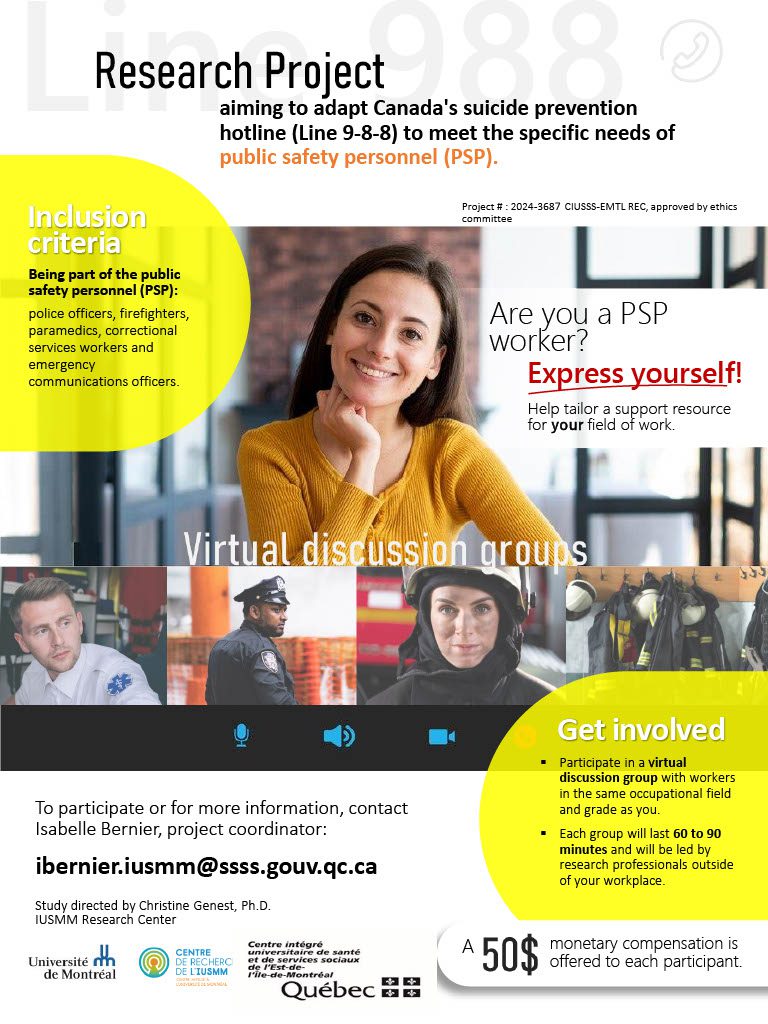
Public safety personnel (PSPs) is an occupational group particularly at risk for suicide behavior (SB). In addition to personal dimensions (age, sex, gender, sexual orientation) that can influence this suicidal risk, professional and organizational dimensions can also influence this risk, such as exposure to potentially psychologically traumatic events (PPTE), the masculine culture associated with these jobs, and the work context (full-time vs. part-time/voluntary; rural vs. urban).
There are various suicide prevention mechanisms, including telephone crisis lines, but PSPs appear unlikely to use such services. The main barriers to using these services are stigma, fear of confidentiality, and the feeling of not being understood by the interveners because of their particular work context. To address this concern, there is a need to offer services tailored to the needs of the PSP population, including the offering of specific services in the context of Canada’s suicide prevention crisis line. It is therefore important to explore what are the cultural specificities and needs of those PSPs and how to adapt services to meet these specificities and needs. If you have any questions, you can contact Isabelle Bernier, the project coordinator, by email at the following address: ibernier.iusmm@ssss.gouv.qc.ca
Understanding suicidal behavior among correctional officers
As part of their duties, correctional officers play a key role in the criminal justice system and the rehabilitation of offenders. They support inmates in their daily lives and social reintegration, monitor the detention environment, and ensure inmates comply with regulations. Their working conditions are complex and the demands are high.
A recent Canadian study demonstrated that the prevalence of suicidal ideation and suicide attempts is significantly higher among Canadian correctional staff than in the general population. However, there is little research on the factors associated with suicidal behaviour among these workers, and even less for provincial correctional officers.
These findings underscore the importance of generating knowledge to better understand how these suicidal behaviours (ideation and attempts) develop. It is also important to understand the specific personal and professional challenges and needs of correctional officers in order to better support them in this essential work.
A team of researchers from the Trauma Studies Center has launched a research project to explore the development of suicidal behaviors among provincial correctional officers. This exploration will provide a comprehensive overview of suicide risk among these officers, an area currently lacking in the scientific literature. This project will be a crucial first step in better tailoring prevention efforts to the specific needs and contexts of correctional officers. The study will generate new knowledge that will support not only research on understanding suicide, but also decision-making at the Ministry of Public Security (MSP) regarding the well-being of staff in correctional facilities.
The specific objectives are:
- To study the risk and protective factors (individual, organizational, social and societal) that influence the development of suicidal behaviors ;
- Identify individual processes,
 organizational and social factors at play in the development of suicide risk over time ;
 - To propose typical scenarios of suicide risk among provincial correctional officers
 organizational and social factors at play in the development of suicide risk over time ;
Photo : Radio-Canada / Gilles Munger
Development of a conceptual framework and a quality of life measurement tool adapted to victims of violence
Post-traumatic stress disorder (PTSD) is recognized as one of the disorders with the most detrimental effects on individuals’ quality of life. The acts of violence to which individuals are subjected result in a high prevalence of trauma and lead to the most severe physical and psychological consequences for victims. There is no conceptual framework for quality of life (QoL) specific to this type of victimization, nor is there a quality of life measure that is adapted and sensitive to their clinical reality.
The project’s objectives are to:
1- Develop a conceptual framework for QoL in order to define the different dimensions and indicators specific to victims of violence.
2- Create a sensitive and appropriate QoL measure for use in clinical research with the target population.
Following a review of the scientific literature, individual interviews with adults exposed to violence and focus groups with psychologists and researchers specializing in trauma and quality of life will be conducted to establish the foundations of the conceptual framework. These interviews and focus groups will help to develop the conceptual framework and identify dimensions and indicators specific to individuals exposed to violence.
[Note: Recruitment for this project is now closed.]